
Mahalakshmi Ashtakam Lyrics with Meaning — Lakshmi Stotra
Laxmi Ashtakam (Mahalakshmi Ashtakam) in Sanskrit with Hindi and English meaning, traditional benefits and how to recite it on Fridays and Diwali.
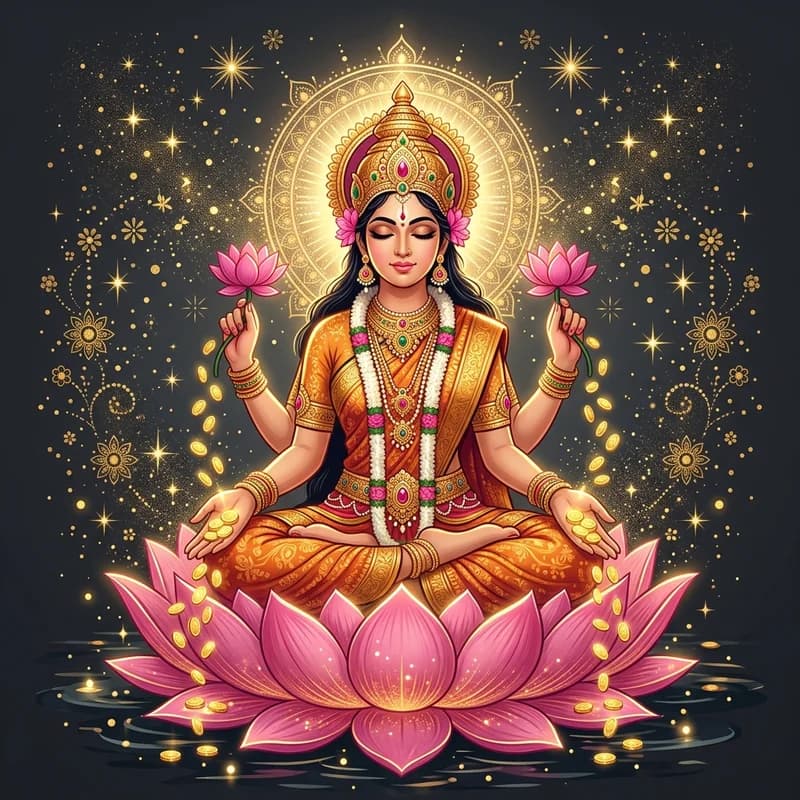
Chaupai 1
नमस्तेऽस्तु महामाये श्रीपीठे सुरपूजिते। शङ्खचक्रगदाहस्ते महालक्ष्मि नमोऽस्तु ते॥
Namaste'stu mahamaye shripithe surapujite. Shankha-chakra-gada-haste mahalakshmi namo'stu te.
Salutations to you, Mahamaya, seated on the throne of prosperity and worshipped by the gods. You hold the conch, the discus and the mace. O Mahalakshmi, I bow to you.
Chaupai 2
नमस्ते गरुडारूढे कोलासुरभयङ्करि। सर्वपापहरे देवि महालक्ष्मि नमोऽस्तु ते॥
Namaste garudarudhe kolasura-bhayankari. Sarva-papa-hare devi mahalakshmi namo'stu te.
Salutations to you who ride on Garuda and who struck fear into the demon Kolasura. Goddess who removes all sins, O Mahalakshmi, I bow to you.
Chaupai 3
सर्वज्ञे सर्ववरदे सर्वदुष्टभयङ्करि। सर्वदुःखहरे देवि महालक्ष्मि नमोऽस्तु ते॥
Sarvajne sarva-varade sarva-dushta-bhayankari. Sarva-duhkha-hare devi mahalakshmi namo'stu te.
You know all things, grant every boon and are a terror to all who do wrong. Goddess who removes all sorrow, O Mahalakshmi, I bow to you.
Chaupai 4
सिद्धिबुद्धिप्रदे देवि भुक्तिमुक्तिप्रदायिनि। मन्त्रमूर्ते सदा देवि महालक्ष्मि नमोऽस्तु ते॥
Siddhi-buddhi-prade devi bhukti-mukti-pradayini. Mantra-murte sada devi mahalakshmi namo'stu te.
You give success and clear understanding, and you grant both worldly fulfilment and liberation. Goddess who is always the very form of mantra, O Mahalakshmi, I bow to you.
Chaupai 5
आद्यन्तरहिते देवि आद्यशक्तिमहेश्वरि। योगजे योगसम्भूते महालक्ष्मि नमोऽस्तु ते॥
Adyanta-rahite devi adya-shakti-maheshvari. Yogaje yoga-sambhute mahalakshmi namo'stu te.
You have no beginning and no end. You are the primal power and the great sovereign goddess. Born of yoga and revealed through yoga, O Mahalakshmi, I bow to you.
Chaupai 6
स्थूलसूक्ष्ममहारौद्रे महाशक्ति महोदरे। महापापहरे देवि महालक्ष्मि नमोऽस्तु ते॥
Sthula-sukshma-maharaudre mahashakti mahodare. Maha-papa-hare devi mahalakshmi namo'stu te.
You are both the visible and the subtle, and you can be fierce. Great power who holds the universe within you, remover of great sins, O Mahalakshmi, I bow to you.
Chaupai 7
पद्मासनस्थिते देवि परब्रह्मस्वरूपिणि। परमेशि जगन्मातर्महालक्ष्मि नमोऽस्तु ते॥
Padmasana-sthite devi parabrahma-svarupini. Parameshi jaganmatar mahalakshmi namo'stu te.
Seated on a lotus, your nature is the Supreme Reality itself. Supreme Goddess and Mother of the world, O Mahalakshmi, I bow to you.
Chaupai 8
श्वेताम्बरधरे देवि नानालङ्कारभूषिते। जगत्स्थिते जगन्मातर्महालक्ष्मि नमोऽस्तु ते॥
Shvetambara-dhare devi nanalankara-bhushite. Jagat-sthite jaganmatar mahalakshmi namo'stu te.
You wear white garments and many ornaments. You are present throughout the world as its Mother. O Mahalakshmi, I bow to you.
Chaupai 9
महालक्ष्म्यष्टकं स्तोत्रं यः पठेद्भक्तिमान्नरः। सर्वसिद्धिमवाप्नोति राज्यं प्राप्नोति सर्वदा॥
Mahalakshmyashtakam stotram yah pathed bhaktiman narah. Sarva-siddhim avapnoti rajyam prapnoti sarvada.
Phalashruti: the devoted person who recites this Mahalakshmi Ashtakam is said to attain every accomplishment and lasting standing.
Chaupai 10
एककाले पठेन्नित्यं महापापविनाशनम्। द्विकालं यः पठेन्नित्यं धनधान्यसमन्वितः॥
Ekakale pathen nityam maha-papa-vinashanam. Dvikalam yah pathen nityam dhana-dhanya-samanvitah.
Reciting it once every day is said to destroy great sins; one who recites it twice every day is blessed with wealth and grain.
Chaupai 11
त्रिकालं यः पठेन्नित्यं महाशत्रुविनाशनम्। महालक्ष्मीर्भवेन्नित्यं प्रसन्ना वरदा शुभा॥
Trikalam yah pathen nityam maha-shatru-vinashanam. Mahalakshmir bhaven nityam prasanna varada shubha.
One who recites it three times every day is said to overcome powerful enemies, and Mahalakshmi remains ever pleased, generous and auspicious towards them.
Laxmi Ashtakam: the Mahalakshmi Ashtakam of Indra
The Laxmi Ashtakam most people look for is the Mahalakshmi Ashtakam, the hymn that begins "Namaste'stu Mahamaye". It has eight verses of praise to Goddess Mahalakshmi and three closing verses, the phalashruti, that describe what reciting it brings. The text opens with "Indra uvacha" ("Indra said"), and tradition attributes it to Indra, king of the devas, placing it in the Padma Purana.
Every verse ends with the same refrain, "Mahalakshmi namo'stu te", which means "O Mahalakshmi, I bow to you." Above you will find the full Sanskrit text with a simple transliteration and the meaning of each verse. Below is what the hymn is about and how I suggest reciting it, especially on Fridays and on Diwali.
A quick note: there is another, different hymn also called "Lakshmi Ashtakam", which opens with "Yasyah kataakshamatrena". If that is the one you were looking for, read it on our Lakshmi Ashtakam (Yasyah Kataksha) page.
What the Mahalakshmi Ashtakam says
The eight verses move from Lakshmi's familiar form to her cosmic one.
- Verses 1 to 3 greet her as Mahamaya, seated on the throne of prosperity and holding the conch, discus and mace. She rides Garuda, struck fear into the demon Kolasura, knows all things and removes sin and sorrow.
- Verses 4 and 5 describe her as the giver of success (siddhi), understanding (buddhi), worldly fulfilment (bhukti) and liberation (mukti). She is the very form of mantra, without beginning or end: the primal power, Adi Shakti.
- Verses 6 to 8 widen the view. She is both the visible and the subtle, seated on a lotus, one with the Supreme Reality (Parabrahman), dressed in white and present throughout the world as its Mother.
So the hymn is not only a prayer for money. It praises Lakshmi as the power behind order, wisdom, well-being and, finally, freedom.
Benefits of the Laxmi Ashtakam, as tradition describes them
The phalashruti (verses 9 to 11) is the hymn's own statement of benefits. It says a devoted reciter gains accomplishment and lasting standing; that reciting it once a day removes great sins, twice a day brings wealth and grain, and three times a day overcomes powerful enemies.
I read these lines as a description of the grace the hymn invokes, not as a contract. In my experience, people who recite the Ashtakam regularly talk less about sudden windfalls and more about:
- a calmer, more grateful relationship with money and the home
- a steadier routine, because a fixed daily practice brings its own discipline
- devotion to Lakshmi as the goddess of order, beauty and well-being, not only of wealth
In Vedic astrology, Lakshmi worship is traditionally linked with Venus (Shukra), whose day is Friday. This is why Friday is the most common day to begin. A stotra is a devotional practice; it does not replace sound financial planning or professional advice.
How to recite the Laxmi Ashtakam
You do not need an elaborate ritual. A sincere, regular practice matters more.
- Choose the day. Friday is traditional. Many people also recite it daily during Navratri, Dhanteras and Diwali.
- Choose the time. Morning after bathing is ideal. Evening also works well, after you light a lamp at sunset.
- Prepare a small space. Place a picture or idol of Mahalakshmi, light a ghee or oil lamp, and offer a flower (a lotus or red flower if available) and some sweet or kheer.
- Settle your mind. Sit facing east or north, take a few slow breaths, and offer a short prayer to Lord Ganesha.
- Recite the eight verses and the phalashruti. Read slowly and clearly. Understanding the meaning matters more than speed.
- Decide the count. The phalashruti mentions once, twice or three times a day. Start with once a day and keep to it. Consistency counts for more than a high number you cannot sustain.
- Close with gratitude. Bow, share the prasad with family members, and keep the lamp burning for a while if it is safe to do so.
Both men and women can recite this stotra. During menstruation, family customs differ; follow your own family's practice, or listen to the recitation silently if you prefer.
Reciting the Laxmi Ashtakam on Diwali
The Mahalakshmi Ashtakam fits naturally into Diwali Laxmi Puja. Recite it after the main offerings and before the aarti.
In 2026, Diwali Laxmi Puja falls on Sunday, 8 November 2026. For New Delhi, the preferred Laxmi Puja muhurat is 5:54 PM to 7:50 PM, the window where pradosh kaal overlaps the fixed (sthir) Vrishabha lagna. Timings shift by city, so check your local panchang for your exact time. The full five-day schedule is in my Diwali 2026 date and Laxmi Puja muhurat guide.
If you are building a fuller Diwali practice, the Lakshmi Chalisa in Hindi makes a good companion to this Sanskrit hymn.
Frequently Asked Questions
Who composed the Mahalakshmi Ashtakam?
Tradition attributes the Mahalakshmi Ashtakam to Indra, king of the devas, and the text itself opens with "Indra uvacha" ("Indra said"). It is traditionally said to come from the Padma Purana.
What is the best time to recite the Laxmi Ashtakam?
Morning after a bath is ideal, and evening after you light the lamp at sunset is also traditional. Fridays, Diwali Laxmi Puja and the days of Navratri are especially popular.
How many times should the Mahalakshmi Ashtakam be recited?
The phalashruti mentions reciting it once, twice or three times a day, and gives a traditional benefit for each. I suggest starting with once a day and keeping that routine steady before you add more.
Can both women and men recite the Laxmi Ashtakam?
Yes, anyone can recite the Mahalakshmi Ashtakam with devotion, whatever their gender or age. For special circumstances, such as during menstruation, follow your family's own custom.
What are the benefits of reciting it on Fridays?
Friday is traditionally associated with Goddess Lakshmi and with Venus (Shukra), so devotees consider it the most fitting day for this hymn. People who keep a Friday practice often describe a calmer, more grateful approach to money and home life, though no specific result is guaranteed.
Start on a Friday
The Laxmi Ashtakam is short enough to learn in a few weeks, yet deep enough to stay with you for a lifetime. Start on a Friday, keep the practice simple, and let the meaning of each verse settle in as you chant.
If you would like guidance on which stotras or remedies suit your own birth chart, especially around Venus and your finances, you are welcome to book a consultation with me.